|
|
 GeoAstro Applets |
 Chaos Game |
 Java |
 Miscel- laneous |
 Physics Quiz |
 Who is Who ? |
 deutsch The Mysterious Eddington-Dirac Number Different relations between atomic and cosmic quantities and fundamental constants are leading to the same large number in the order of magnitude of 1040.
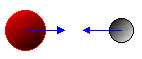
The electrostatic
force between an electron and a proton
and the
gravitational force 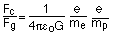
= 2,27·1039 For two electrons the ratio becomes
2. Lengths The "classic electron radius" r can be computed assuming that the energy W=mec2 is equal to the potential energy of the elementary charge e spread over a sphere of radius r: 
r = 3·10-15 m The ratio of this "elementary length" to the radius of the universe R = c·t = 1·1026 m is a number of the same order of magnitude as in (1). 3. Times The light takes the time t to pass the elementary length This "elementary time" is contained in age of the universe T = 6,2·1017 s by a number of the same order of magnitude as in (1) and (2):
4. Particles The mass M of the universe 2,4·1051 kg to 2,0·1052 kg compared to the mass of a proton mp = 1,67·10-27 kg is the number of protons and the number of particles (protons and electrons) is This is nearly the square of the number found in (1), (2) and (3) !
By chance or not ? Dirac suggested in 1937 that this
coincidence could be understood if fundamental
constants - in particular, G - varied as the
Universe aged. Robert Dicke pointed out in 1957 and 1961
that the age of the universe, as seen by living
observers, cannot be random: The coincidence is is a
consequence of the fact that 'carbon is required to
make physicists' to observe the universe. The order
of magnitude of the lifespan of a main sequence star
(Sun: 10·109 years) agrees with the result derived by
Dirac. Another
strange coincidence:
The ratio c2/G (square of the
speed of light c divided by the gravitational
constant G) is nearly the same as the the ratio M/R
(mass M of the universe and radius R of the visible
universe): c2 /
G = M / R c2/G
=
(2.998·108
m/s)2/[6.674·10-11 m3/(kg
s2)] c2/G = 1.4*1027 kg/m Computing the radius R of the visible universe by c and the age T of the
universe:
R = c·T and the mass M of the
universe by the number of nucleons n = 1.2*1080
of mass m=1.67*10-27 kg M = n·m
= 2.00·1053
kg M/R
= 1.5·1027 kg/m c2/G
=
M/R is equivalent to G·M/(R·c2)
=1 6.674·10-11 m3/(kg
s2) ·
2.00·1053 kg /
[1.30·1026
m ·
(2.998·108
m/s)2] = 1.1 ------ The relation G·M/(R·c2)
can be written as the ratio of G·M·M/R and M·c2 where
G·M·M/R
is the gravitational
potential
energy for a partical of mass M in
its own gravitational field, and M·c2
is the rest enrgy of mass m.
the radius R of the universe is half of
the Schwarzschild radius RS of a mass
M: RS = 2·G·M
/ c2 Is the universe a black hole,
or a white hole ? The expression c2·R /M = 5,8·10-11
m3/(kg s2) is nearly the constant of gravitation: G = 6.67·10-11 m3/(kg s2)
Last modified: 2017, Nov 11 |
||||||||||||||||||||