GeoAstro
Applets

Astronomy

Chaos Game

Java

Miscel-
laneous

Physics Quiz

Who is
Who ?
|
|
GeoAstro Applets |
Astronomy |
Chaos Game |
Java |
Miscel- laneous |
Physics Quiz |
Who is Who ? |
|
The Roche Limit The Roche limit is the minimum orbital radius which is necessary for dust or particles to grow forming a moon, or necessary for an existing moon to remain internally stable. It is named after Édouard Roche (1820 – 1883).
Determining the Roche limit
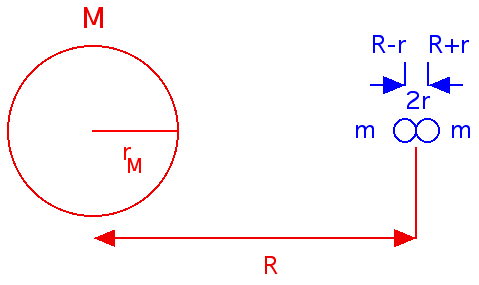
Two
particles (mass m, radius r) orbiting the planet
(mass M) will be bound, if their mutual
gravitational force F =
G*m*m/(2r)2 is
greater than the difference of the gravitational
forces ((tidal force) exerted
by the body of mass M on the
particles at R-r and R+r ΔF = F2 - F1 = G*m*M/(R-r)2 - G*m*M/(R+r)2 ΔF =
(G*m*M/R2)*[1/(1-r/R)2 -
1/(1+r/R)2]
For
m<<M (or r/R<<1):
1/(1-r/R)2 - 1/(1+r/R)2
≈ 1/(1-2r/R) - 1/(1+2r/R)
≈ 1+2r/R - (1-2r/R) =
4r/RThe
Roche limit is given by the condition:
ΔF =
F
(G*m*M/R2)*4r/R = G*m*m/(4r2) M*4r/R3 = m/(4r2) R = r*(16*M/m)1/3 ≈ 2.5*r*(M/m)1/3 Using the densities of the bodies m=ρm*4π*r3/3 and M=ρM*4π*rM3/3: R =
r*(16*M/m)1/3 = rM*(16*ρM/ρm)1/3 In case
of equal densities, ρM
= ρm R ≈ 2.5*rM
In the solar system the orbits of the Earth's moon and of the Earth are in a region of stability. The Hill
Sphere
An
astronomical body's Hill sphere is the region in
which it dominates the attraction of satellites.
It is named after John William Hill (1812–1879).
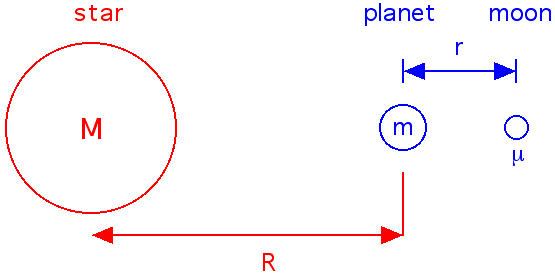 Determining the Hill Sphere radius The satellite or moon (mass μ) is orbiting the star (mass M) with the same angular velocity ω at the distance R+r as the planet (mass m) at the distance R (permanent full moon position). The equilibrum condition for the planet is: m ω2
R = G m M/R2
ω2 = GM/R3 The satellite
is dragged by the combined gravitational
forces exerted by the star and the planet:
μ ω2 (R+r) = G μ M/(R+r)2 + G μ m/r2
Inserting
ω2:
G μ M (R+r)/R3 = G μ M/(R+r)2 + G μ m/r2 M (R+r)/R3 = M/(R+r)2 + G m/r2 M (R+r)3 r2 = M R3 r2 + m R3 (R+r)2 m R3 (R+r)2 = M r2 (R3+3R2r+3Rr2+r3) - M R3 r2 m R3 (R+r)2 = M r3 (3R2+3Rr+r2) For
r<<R: (R+r)2
≈ R2, and 3Rr+r2 ≈ 0.
The equation simplifies:
m R5 = 3 M r3 R2
m R3 = 3 M r3 r = R [m/(3M)]1/3
Last update 2015, Jun 18 |