|
|
 GeoAstro Applets |
 Chaos Game |
 Java |
 Miscel- laneous |
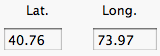 |
Enter latitude and longitude in
decimal degrees: northern latitudes positive, southern negative, eastern longitudes positive, western negative. |
 |
Enter the time zone: east of Greenwich positive, west of Greenwich negative. |
  |
You may use the keys "h",
"d", "m", "y" to increase the hour, date, month, or year or Shift key and "h", "d", "m", "y" to decrease the hour, date, month or year ! Click the applet first ! |
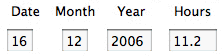 |
Enter date, month, year (integer), and local time (decimal hours). |
 |
Hit "apply input" to enter
your input data. |
Select from the "Window..." menu to open the windows:
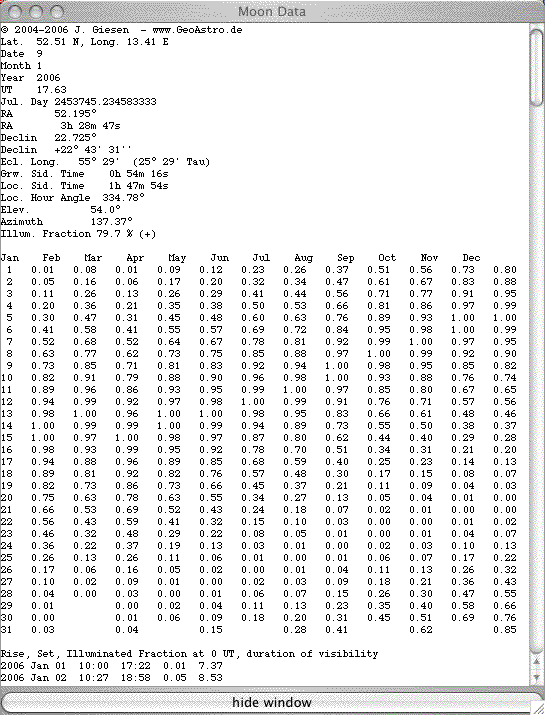
The
tables:
Fraction of the Moon Illuminated 2006, at Midnight Universal
Time,
and Times of Rise and Set.
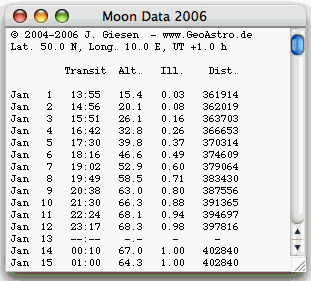
Scroll
down
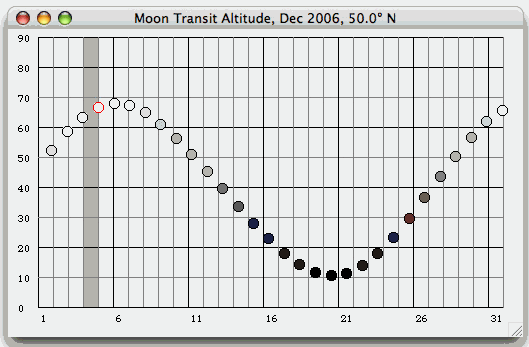
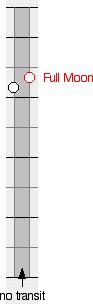
to see extreme circumstances at full Moon:
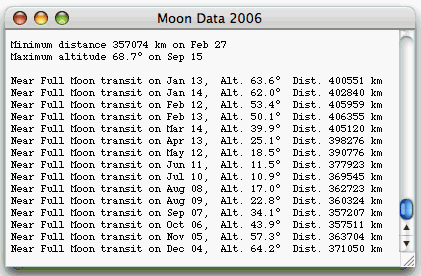
For
viewers
in the northern hemisphere, the full Moon of December
2006 will be the highest until 2024,
for southern hemisphere observers it will be the lowest.
 Highest
Full
Moons in 18 Years
Highest
Full
Moons in 18 Years
On
October 6, 2006, the Moon is Full: it's the Harvest Moon, the
closest Full Moon to automn equinox.
That night, it has nearly the biggest apparent diameter for a
Full Moon in 2006 with a diameter of 33.4'.
Select
"Full
Moon":
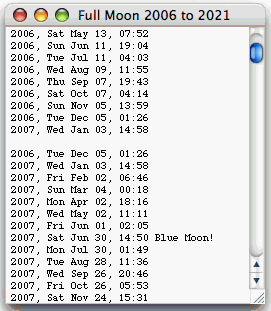
The
second
full moon in a month is called a blue moon.
Blue moons happen roughly once every three years, or about
seven times every 19 years (times are UT):
| 2007, Sat Jun 30, 13:50 2009, Thu Dec 31, 19:14 2012, Fri Aug 31, 13:59 2015, Fri Jul 31, 10:44 2018, Wed Jan 31, 13:28 2018, Sat Mar 31, 12:38 2020, Sat Oct 31, 14:50 2023, Thu Aug 31, 01:37 2026, Sun May 31, 08:46 2028, Sun Dec 31, 16:50 2031, Tue Sep 30, 18:59 2034, Mon Jul 31, 05:56 2037, Sat Jan 31, 14:05 2037, Tue Mar 31, 09:55 2039, Mon Oct 31, 22:37 2042, Sun Aug 31, 02:04 2045, Tue May 30, 17:54 2048, Fri Jan 31, 00:16 2050, Fri Sep 30, 17:33 |
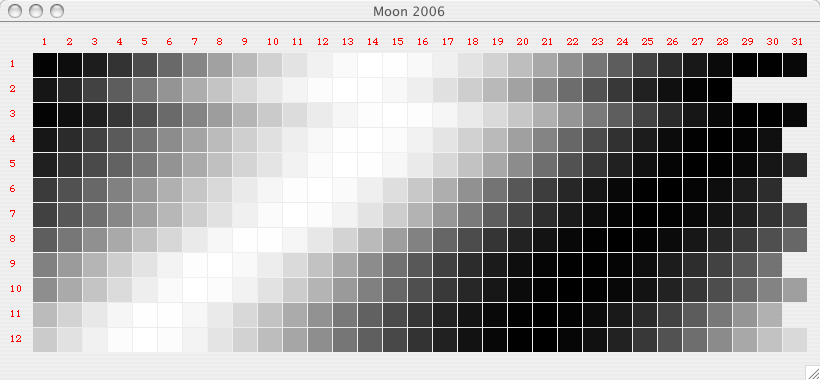
Fraction of the Moon Illuminated 2006, at Midnight Universal Time.
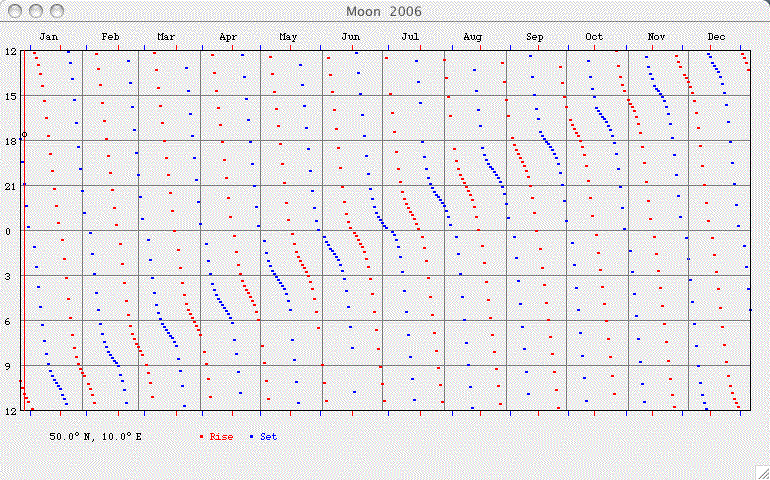
Interactive map of rise and set.
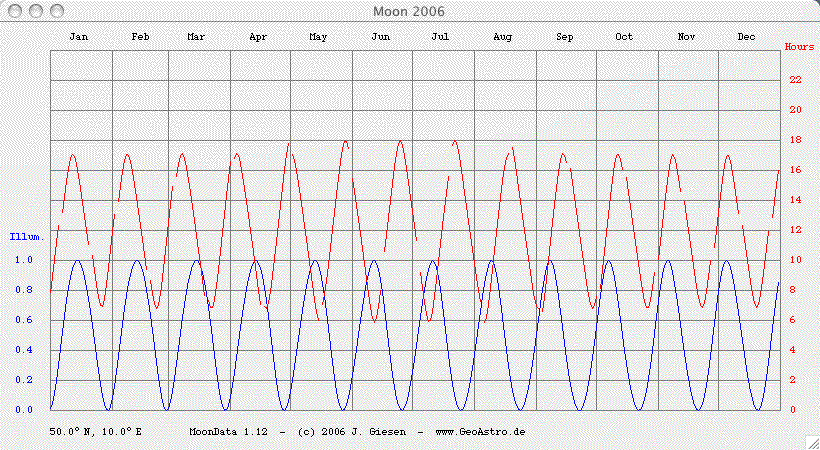
Illuminated fraction, and the duration of visibility
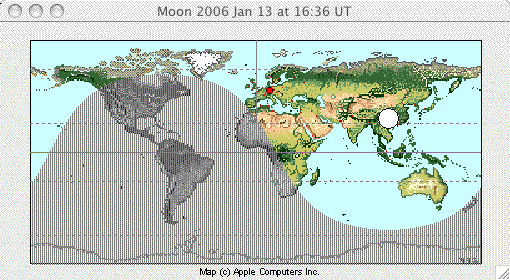
The Moon on a world map, and the moonlit region.
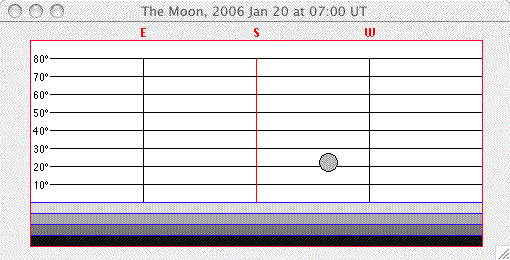
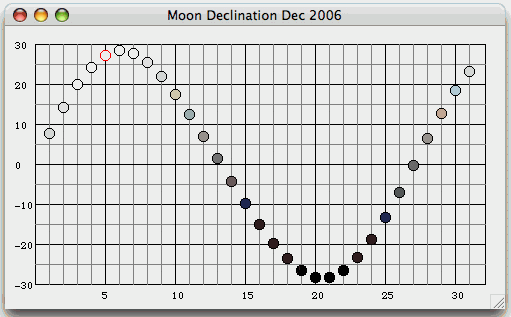
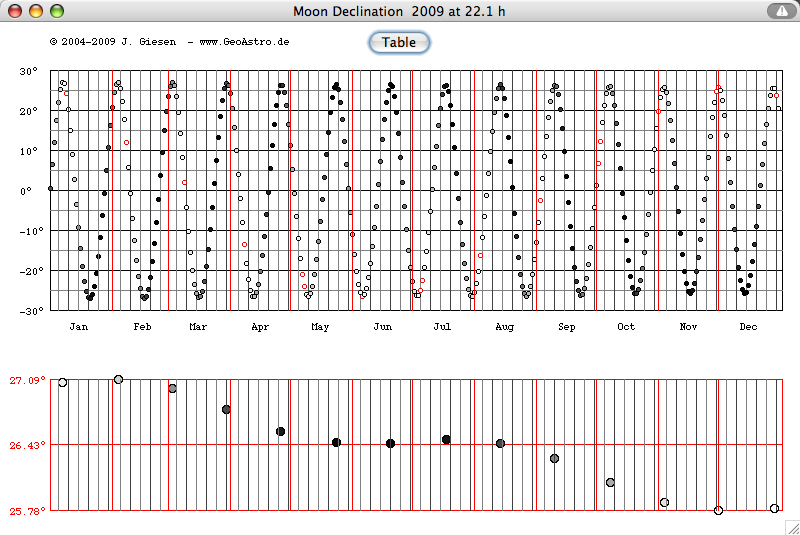
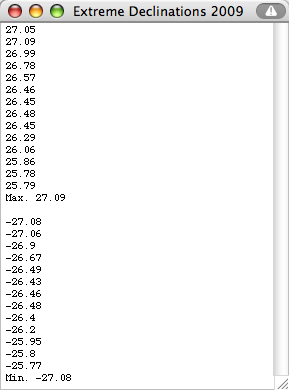
The
declination
of the Moon.
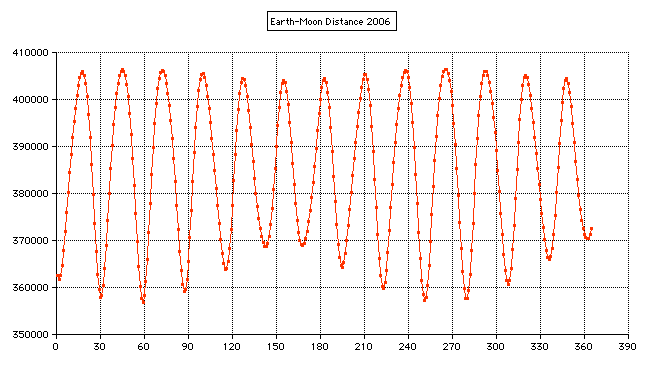
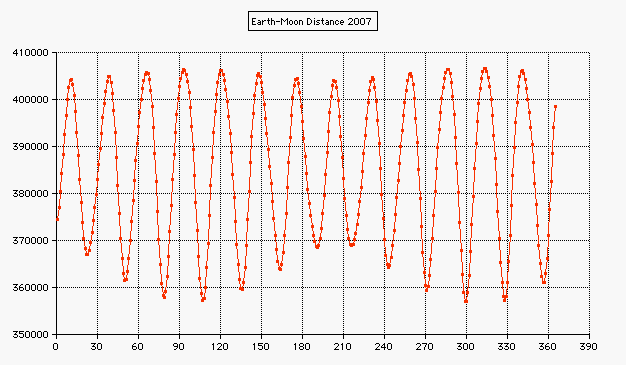
The change of distance may be up to about 6,300 km per day.
More data and Moon Distance Applet

Updated:
2023,
Oct 06